







Local SEO Services for Businesses vs Traditional SEO: What’s the Difference?
Understanding the distinction between local SEO services for businesses and traditional SEO is essential for choosing the right strategy to grow your customer base. While both aim to improve search visibility, they serve fundamentally different purposes and audiences. Local SEO services for businesses focus on attracting nearby customers through Google Business Profile optimisation, local citations, and review management, while traditional SEO targets broader, often national or international audiences through content marketing and backlink acquisition. Choosing the wrong approach means wasted budget and missed opportunities—this guide breaks down exactly when and why to use each.
What Is Local SEO?
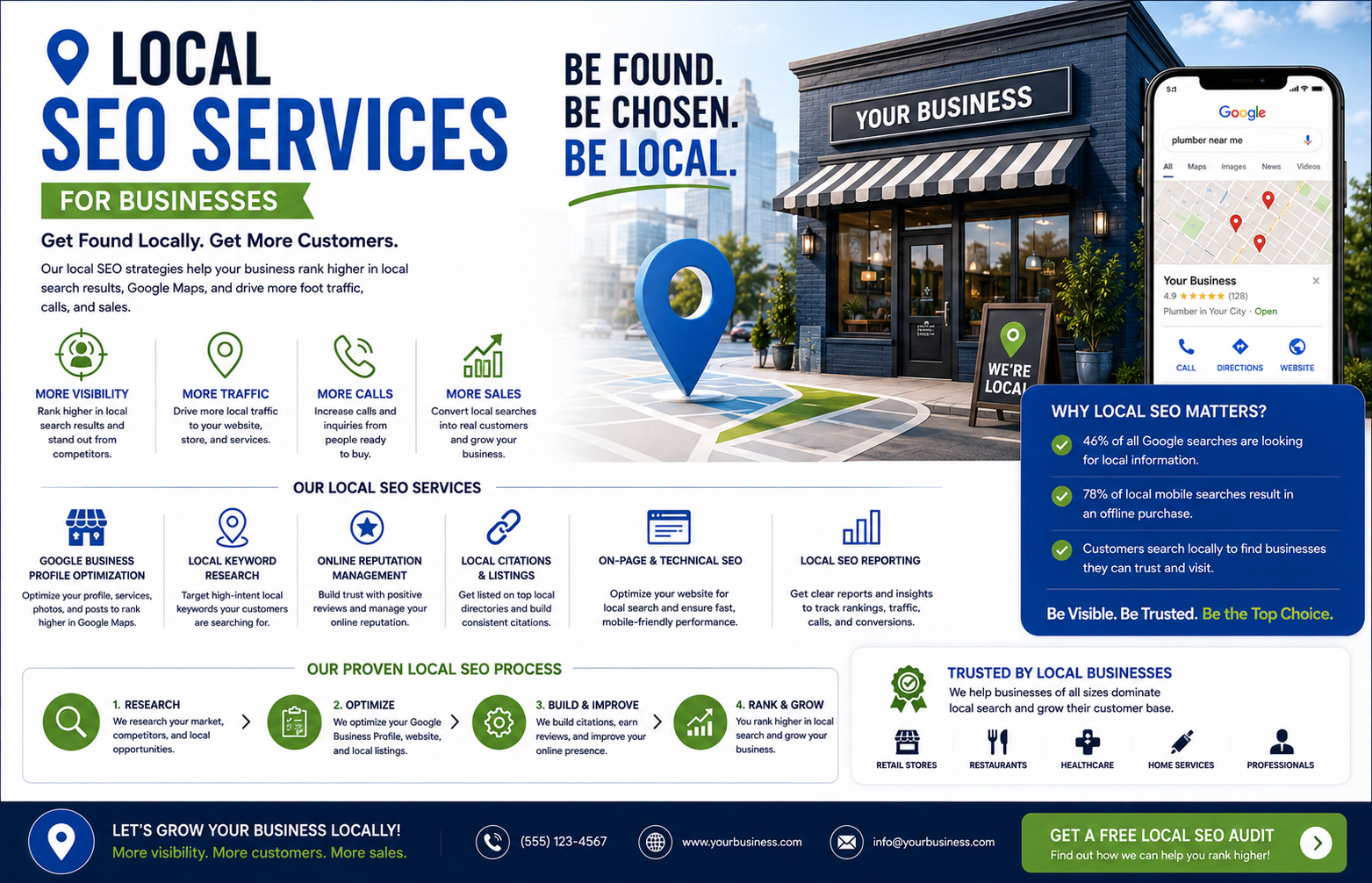
Local SEO is a specialised branch of search engine optimisation that helps businesses appear in location-based searches. It targets “near me” queries and includes Google Business Profile optimisation, local citations, review generation, and location-specific landing pages. The goal is to drive foot traffic, phone calls, and local enquiries.
What Is Traditional SEO?
Traditional SEO (sometimes called “organic” or “national” SEO) focuses on improving a website’s visibility in non-geographically-restricted searches. It relies on content marketing, backlink building, technical optimisation, and broad keyword targeting to attract audiences regardless of location.
Key Differences Between Local SEO Services for Businesses and Traditional SEO
1. Target Audience
| Aspect | Local SEO | Traditional SEO |
|---|---|---|
| Geographic focus | Specific city, region, or postcode | National or global |
| Customer intent | Immediate action (visit, call, book) | Research and consideration |
| Typical searcher | “Near me” or “[service] + [city]” | Broad informational or commercial queries |
2. Keyword Strategy
Local SEO targets keywords with geographic modifiers (“plumber in Manchester,” “best coffee shop near me”), while traditional SEO targets high-volume, non-location-specific keywords (“how to fix a leaky tap,” “best coffee brewing methods”).
3. Core Tactics
| Tactic | Local SEO | Traditional SEO |
|---|---|---|
| Google Business Profile | Essential, active optimisation | Not applicable |
| Local citations | Critical (Yelp, directories, Chamber of Commerce) | Minimal impact |
| Reviews | Major ranking and trust factor | Helpful but not as critical |
| Backlinks | Local sources (community organisations, local news) | Broad authority sites |
| Content strategy | Location-specific landing pages | Broad topic clusters and pillar pages |
| Schema markup | LocalBusiness schema | Article, Product, FAQ schema |
4. Ranking Factors
Local SEO ranking factors:
-
Google Business Profile completeness and activity
-
Review volume, recency, and sentiment
-
Citation consistency across directories
-
Local backlinks
-
Proximity to searcher
Traditional SEO ranking factors:
-
Content quality and relevance
-
Backlink authority and quantity
-
Technical SEO (site speed, Core Web Vitals, mobile-friendliness)
-
On-page optimisation (headings, meta tags, internal linking)
-
User engagement metrics
5. Conversion Goals
| Goal | Local SEO | Traditional SEO |
|---|---|---|
| Primary conversion | Phone calls, direction requests, store visits | Form submissions, newsletter signups, eCommerce purchases |
| Secondary conversion | Appointment bookings, quote requests | Content engagement, resource downloads |
| Typical timeline | Immediate to same-day | Days to weeks |
When to Use Local SEO Services for Businesses
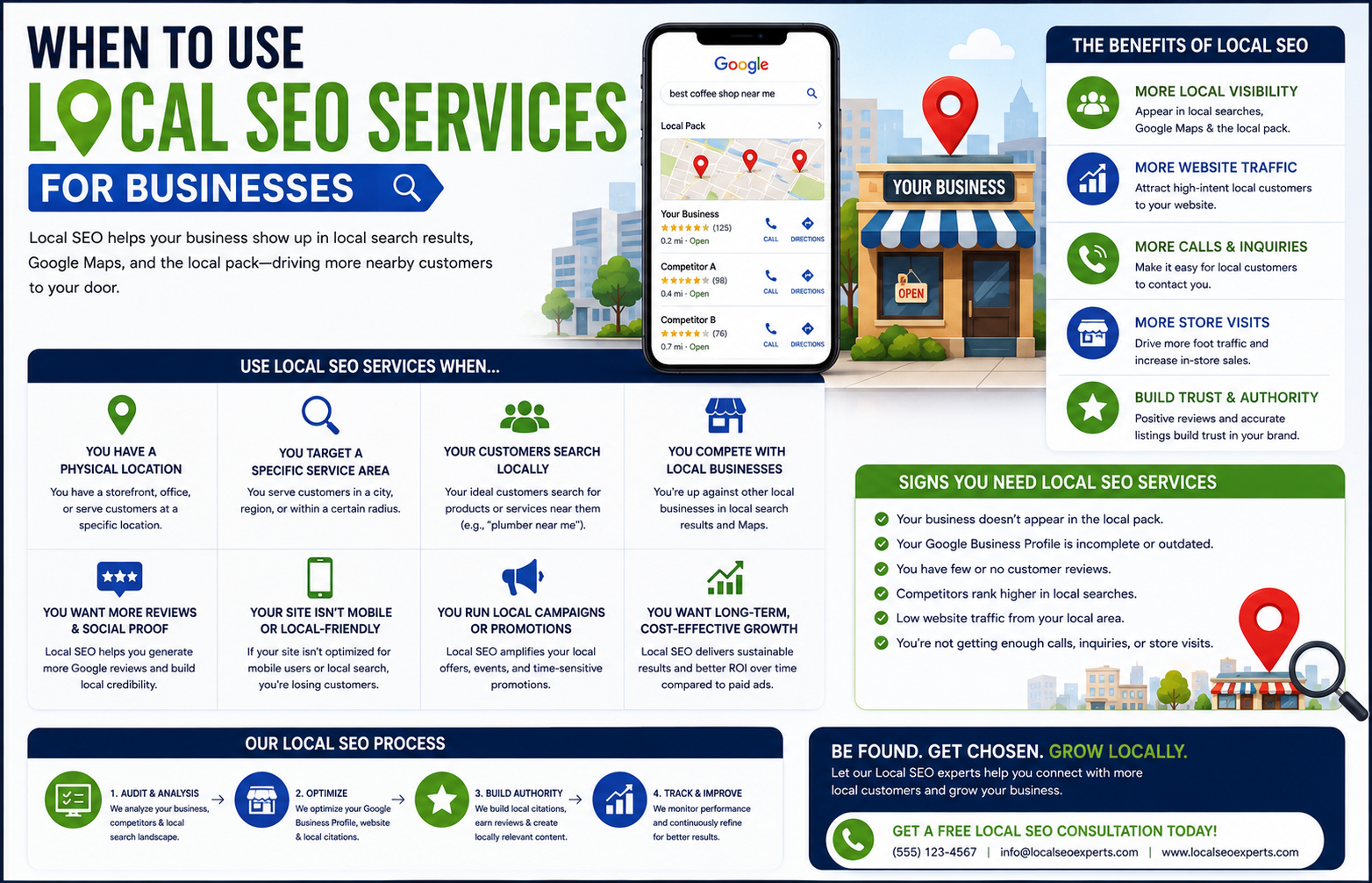
You need local SEO if:
-
You have a physical location customers visit (retail store, restaurant, dental practice)
-
You serve a specific geographic area (plumber, electrician, landscaper)
-
Most of your customers come from within a 5-20 mile radius
-
“Near me” searches drive a significant portion of your enquiries
When to Use Traditional SEO
You need traditional SEO if:
-
You sell products online to a national or international audience
-
Your services are location-agnostic (software, consulting, digital products)
-
You operate multiple locations but target a national brand presence
-
Your customers rarely visit a physical location
Can They Work Together?
Absolutely. Many businesses combine both strategies:
-
Multi-location brands use traditional SEO for brand authority and local SEO for each storefront
-
Service-area businesses with national aspirations use traditional SEO for thought leadership and local SEO for immediate leads
-
Ecommerce with local pickup uses traditional SEO for product visibility and local SEO for in-store traffic
Common Mistakes to Avoid
| Mistake | Why It Hurts | Fix |
|---|---|---|
| Using traditional SEO for a local business | Misses “near me” and map pack visibility | Prioritise GBP and local citations |
| Using local SEO for a national brand | Limits reach and misses broader audience | Balance both strategies |
| Ignoring reviews | Misses trust signals and ranking boost | Actively manage review generation and response |
| Inconsistent NAP across directories | Confuses search engines and customers | Audit and correct citations regularly |
| No location-specific landing pages | Misses hyper-local search opportunities | Create unique pages for each location or service area |
Measuring Success
| Metric | Local SEO | Traditional SEO |
|---|---|---|
| Primary KPIs | Phone calls, direction requests, store visits | Organic traffic, keyword rankings, conversions |
| Tracking tools | Google Business Profile insights, call tracking | Google Analytics, Search Console, rank trackers |
| Reporting frequency | Weekly to monthly | Monthly to quarterly |
| Key benchmarks | Local pack rankings, review growth, citation consistency | Organic revenue, branded vs non-branded traffic split |
Conclusion
Want local SEO services for businesses that drive phone calls, foot traffic, and local enquiries—or traditional SEO that builds national authority and organic revenue?
Get in touch with Orbitix today.