







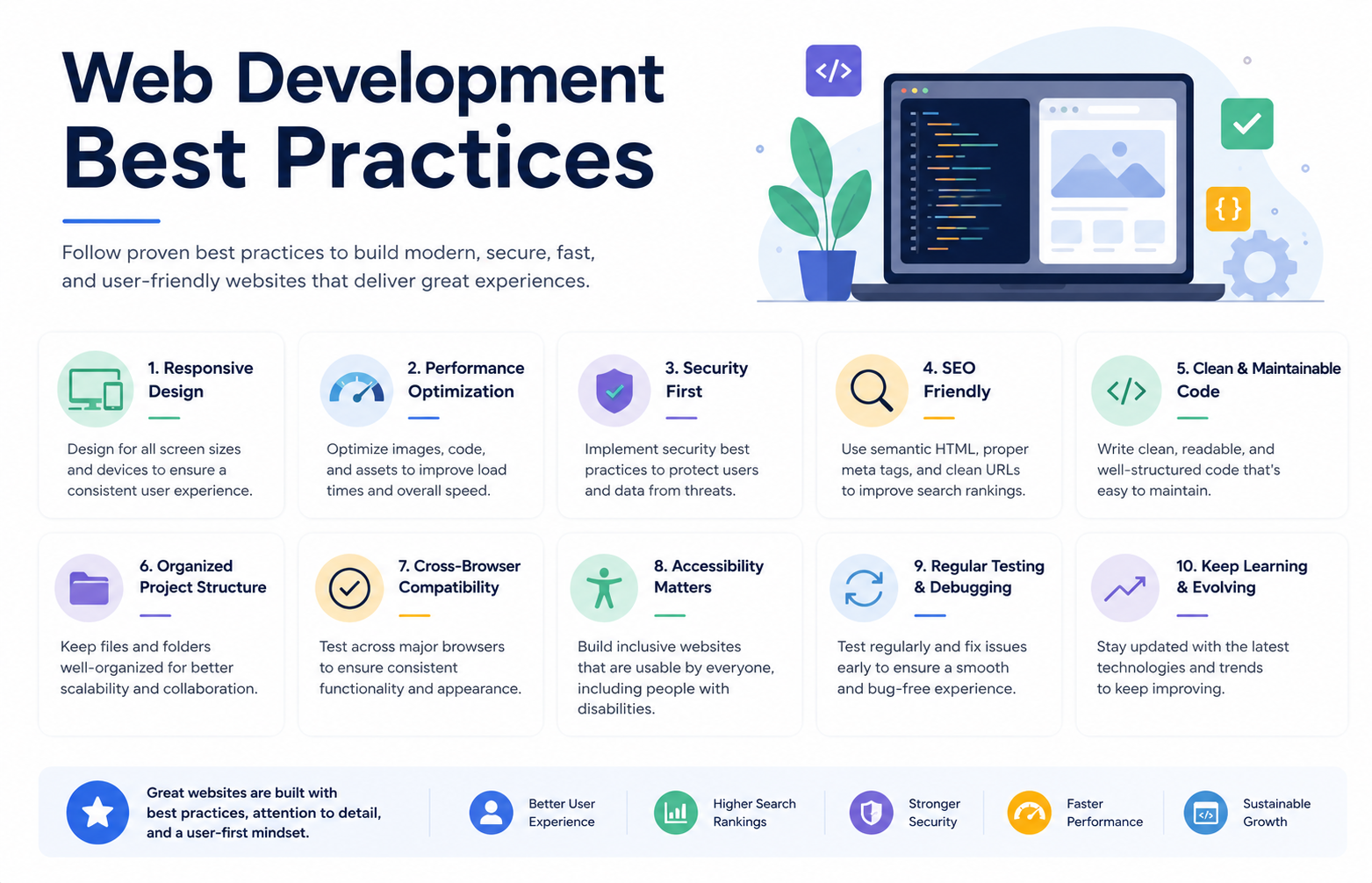
Web Development Best Practices That Improve Speed, Security & SEO
Implementing strong web development best practices is essential for building websites that are fast, secure, and visible to search engines. When approaching web development in Cambridge, businesses should focus on performance optimization, security hardening, accessibility, and structured data. While frameworks and technology stacks change, the fundamentals of web development best practices remain consistent. Research consistently shows that slower websites lead to higher bounce rates and lower conversion rates, while properly structured content helps both search engines and AI systems understand your site’s purpose.
Why a Balanced Approach Matters
Effective web development requires a holistic approach balancing performance optimization, security and compliance, and SEO considerations . A technically impressive website that loads slowly won’t achieve its full potential, and secure code is meaningless if users can’t find it.
Core Web Development Best Practices for Speed, Security & SEO
Performance Optimization
Performance remains one of the strongest predictors of user satisfaction . Core Web Vitals now define the standard:
| Metric | Target | Impact |
|---|---|---|
| Largest Contentful Paint (LCP) | Under 2.5 seconds | Perceived load speed |
| Interaction to Next Paint (INP) | Under 200ms | Responsiveness to clicks/taps |
| Cumulative Layout Shift (CLS) | Under 0.1 | Visual stability |
Implementation tips:
-
Image optimization: Use modern formats like WebP and AVIF, implement lazy loading for below-the-fold content, and compress images without quality loss .
-
Code efficiency: Minify CSS/JS, enable caching, and consider edge caching and CDNs to deliver assets from locations closer to users .
-
Break long tasks: Use
scheduler.yieldor manual chunking to prevent JavaScript from blocking user interactions . -
Performance budgets: Enforce Core Web Vitals targets in CI to catch regressions before they reach production .
Security Best Practices
Security vulnerabilities can compromise sensitive user data and damage trust. Essential practices include:
-
Content Security Policy (CSP): Implement nonce-based or hash-based CSP to prevent cross-site scripting (XSS) attacks .
-
Security headers: Use Mozilla’s HTTP Observatory to check for missing headers that could expose your site to attacks .
-
Dependency hygiene: Use automated scanning (Dependabot, Snyk) gated in CI/CD to catch vulnerable and outdated components .
-
HTTPS everywhere: Encrypt all data transmission .
-
Input validation: Defend against injection attacks and ensure proper output encoding .
Structured Data and SEO
Search engines and AI systems increasingly rely on structured information to understand website content . Proper implementation includes:
-
Schema markup: Use JSON-LD structured data for products, articles, organizations, events, and reviews .
-
Semantic HTML: Implement modern HTML architecture with proper heading hierarchy (H1, H2, H3) .
-
Meta tags: Optimize title tags, meta descriptions, and Open Graph tags for social sharing .
-
Dynamic sitemaps and
robots.txt: Help search engines discover and prioritize your content .
Accessibility (Inclusive Design)
Accessibility is both an ethical obligation and a business imperative—companies have faced multimillion-dollar lawsuits for inaccessible websites . Key practices include:
-
Semantic HTML: Use appropriate elements like
<button>,<nav>,<main>for native accessibility . -
ARIA attributes: Implement labels for interactive elements and error announcements for screen readers .
-
Keyboard navigation: Ensure all functionality works without a mouse .
-
Colour contrast: Meet WCAG 2.2 standards for readability .
-
Alt text: Provide descriptive text for all images .
Mobile-First and Responsive Design
With mobile traffic dominating the web, responsive design is non-negotiable:
-
Mobile-first approach: Design for small screens first, then scale up .
-
Fluid grids and
min-widthmedia queries: Ensure layouts adapt across devices . -
Touch targets: Minimum 44×44 pixels for buttons and interactive elements.
-
Test on real devices: Use BrowserStack or similar tools for cross-browser and device testing .
Clean Code and Maintainable Architecture
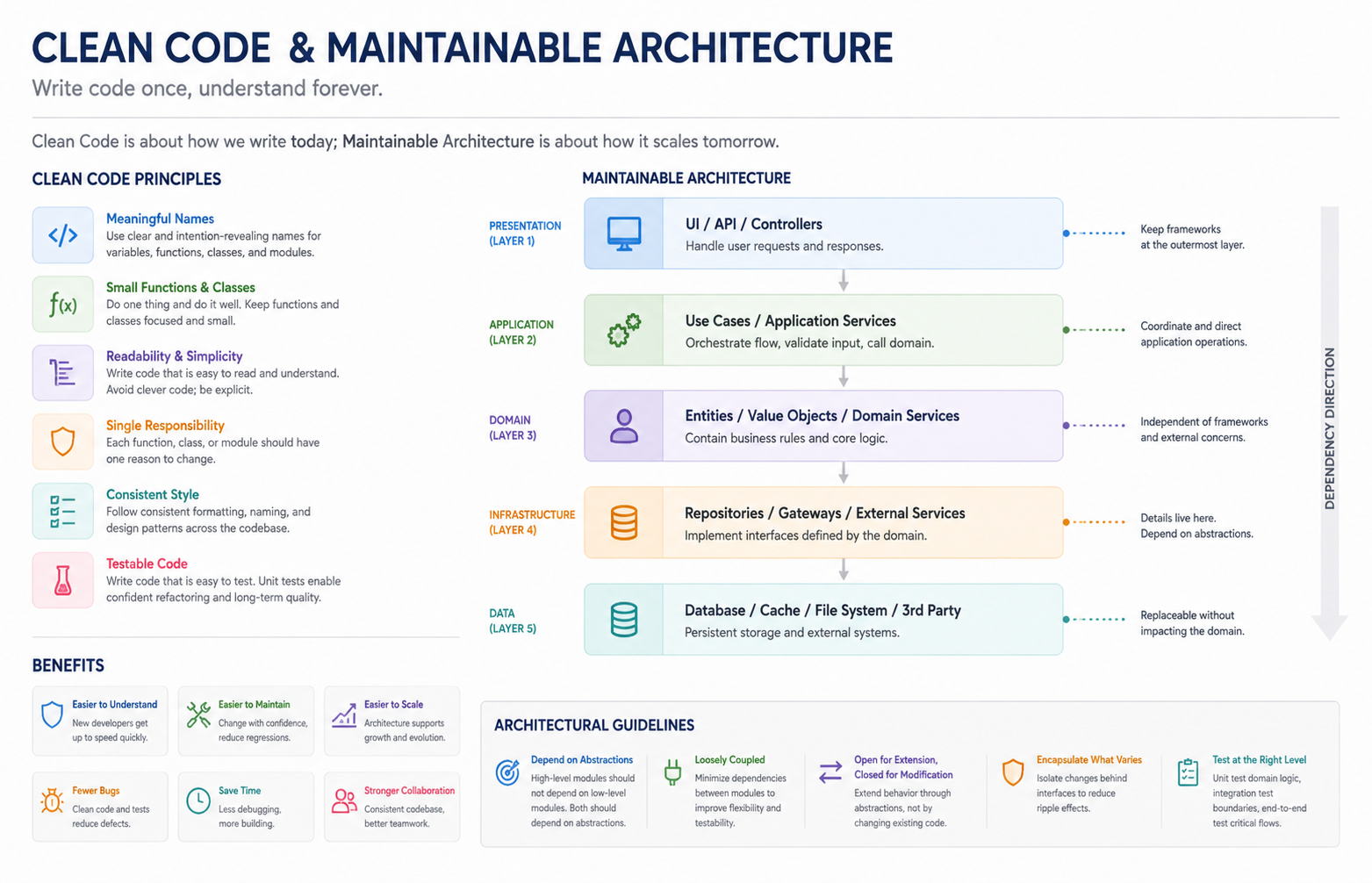
Code quality directly influences maintainability and team velocity :
-
Meaningful naming: Choose clear, descriptive names for variables, functions, and components.
-
Single responsibility: Each function should do one thing .
-
Component-driven architecture: Build reusable UI elements with clear interfaces .
-
Follow framework conventions: Don’t invent new structures that future developers won’t understand .
Common Mistakes to Avoid
| Mistake | Why It Hurts | Fix |
|---|---|---|
| Ignoring Core Web Vitals | Poor mobile performance kills rankings and conversions | Enforce performance budgets in CI |
| Missing security headers | Vulnerability to XSS and injection attacks | Use Mozilla HTTP Observatory |
| No structured data | Misses AI visibility and rich snippets | Implement JSON-LD schema |
| Neglecting accessibility | Legal risk, excludes users with disabilities | Follow WCAG 2.2 guidelines |
| Skipping testing | Bugs reach production | Implement CI/CD with automated tests |
| Over-engineering | Adds complexity without value | Start simple, refactor as needed |
Conclusion
Web development best practices in 2026 demand a balanced approach across performance, security, SEO, accessibility, and clean code. Businesses looking for website development SEO services should prioritise these areas to build websites that load fast, protect user data, rank well in search, and serve all users effectively. As one developer noted, these four areas—performance, accessibility, best practices, and SEO—are not separate but must work together in perfect balance.
Want web development that follows best practices for speed, security, and SEO—with a partner who gets the balance right?
Get in touch with Orbitix today.