






Discover the SEO Tools That Can Transform Your Website’s Performance
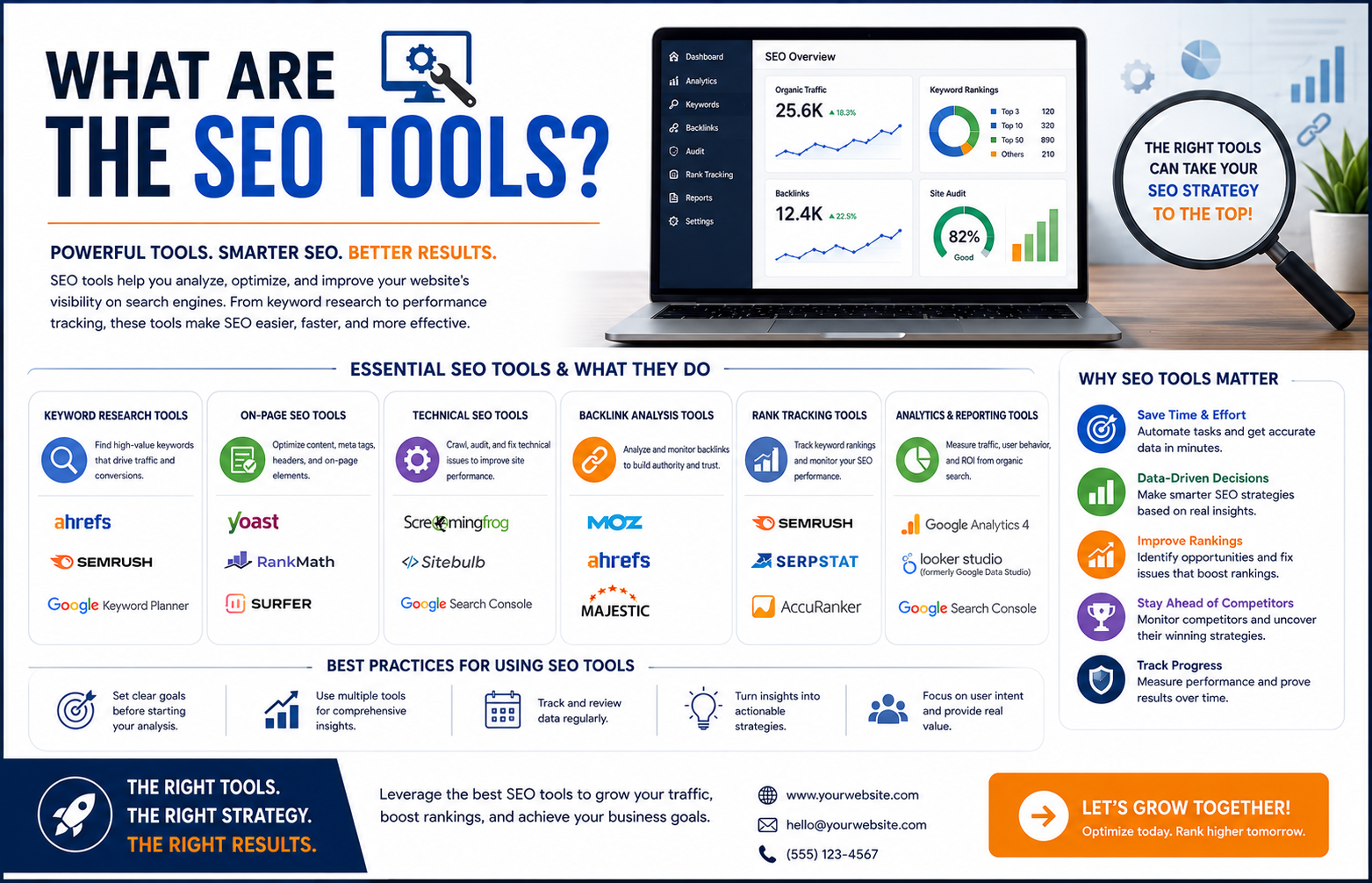
Understanding what are the SEO tools needed to improve your website’s performance is the first step toward sustainable organic growth. SEO software helps you conduct keyword research, perform technical audits, track rankings, optimize content, and measure results—all essential activities for improving search visibility. Following a technical SEO checklist alongside these tools ensures that critical issues are identified and resolved efficiently. The right SEO tools make it possible to identify exactly what’s holding your site back and take targeted action to fix it. This guide explains the core categories of SEO tools and recommends the best options for each.
Why SEO Tools Are Essential
Organic search remains the single largest driver of digital traffic, accounting for 94% of all clicks . SEO tools help you:
-
Find the right keywords your audience is searching for
-
Identify technical issues that block search engines from ranking your pages
-
Track your rankings to see if your efforts are working
-
Optimize content to match what top pages are doing
-
Measure ROI with reporting that connects SEO to revenue
According to a HubSpot survey, 27% of marketers agreed that website, blog, and SEO delivered the biggest ROI of any marketing channel this year . The key is having the right stack of tools to execute effectively.
The Five Essential Categories of SEO Tools
To understand what are the SEO tools you actually need, it helps to group them by function:
1. Keyword Research Tools
Keyword research is the starting point for almost every SEO initiative. It determines what content gets created and which terms pages are optimized to rank for .
Top recommendations:
-
Semrush – 26.6B keyword database with intent filters and gap analysis. Best all-in-one platform .
-
Ahrefs – 28.7B keyword database with accurate difficulty scores and click metrics .
-
AnswerThePublic – Visual question-mapping tool showing what people actually ask around any topic. Free tier available .
-
Mangools KWFinder – Beginner-friendly keyword research with intuitive difficulty scoring .
2. Technical SEO Audit Tools
Technical SEO covers the behind-the-scenes factors that determine whether search engines can crawl, index, and understand your site. SEO tools help by scanning for issues like broken links, duplicate content, slow load times, and indexing errors .
Top recommendations:
-
Screaming Frog – Desktop-based crawler that digs through your site to surface technical issues. Free for up to 500 URLs .
-
Lumar (formerly Deepcrawl) – Enterprise platform for managing large, complex sites .
-
Google Search Console – Free tool showing exactly how your site performs in Google Search .
3. Rank Tracking Tools
Rank tracking shows where pages stand in search results over time, making it possible to connect SEO work to actual outcomes .
Top recommendations:
-
STAT Search Analytics – Daily SERP rank tracking with city-level local precision .
-
SE Ranking – AI and machine learning tools for keyword tracking .
-
SERP Robot – Budget-friendly daily position checks across multiple search engines .
4. Content Optimization Tools
On-page optimization covers titles, headers, body content, internal links, and image alt text. SEO tools score content against ranking pages and flag missing elements .
Top recommendations:
-
SurferSEO – Real-time content scoring against top-ranking pages. $99/month starting .
-
Clearscope – Grading system comparing your draft with top-ranking pages .
-
Frase.io – Combines SEO and GEO (Generative Engine Optimization) scoring .
5. Reporting & Analytics
Reporting turns SEO activity into evidence that the channel is working, which is often the difference between a program that keeps its budget and one that doesn’t .
Top recommendations:
-
Google Analytics (GA4) – Site-wide traffic and behavior data across all channels .
-
Google Search Console – Clicks, impressions, position, and CTR data straight from Google .
-
Google Data Studio – Pulls multiple data sources into shareable dashboards .
SEO Tool Comparison Cheat Sheet
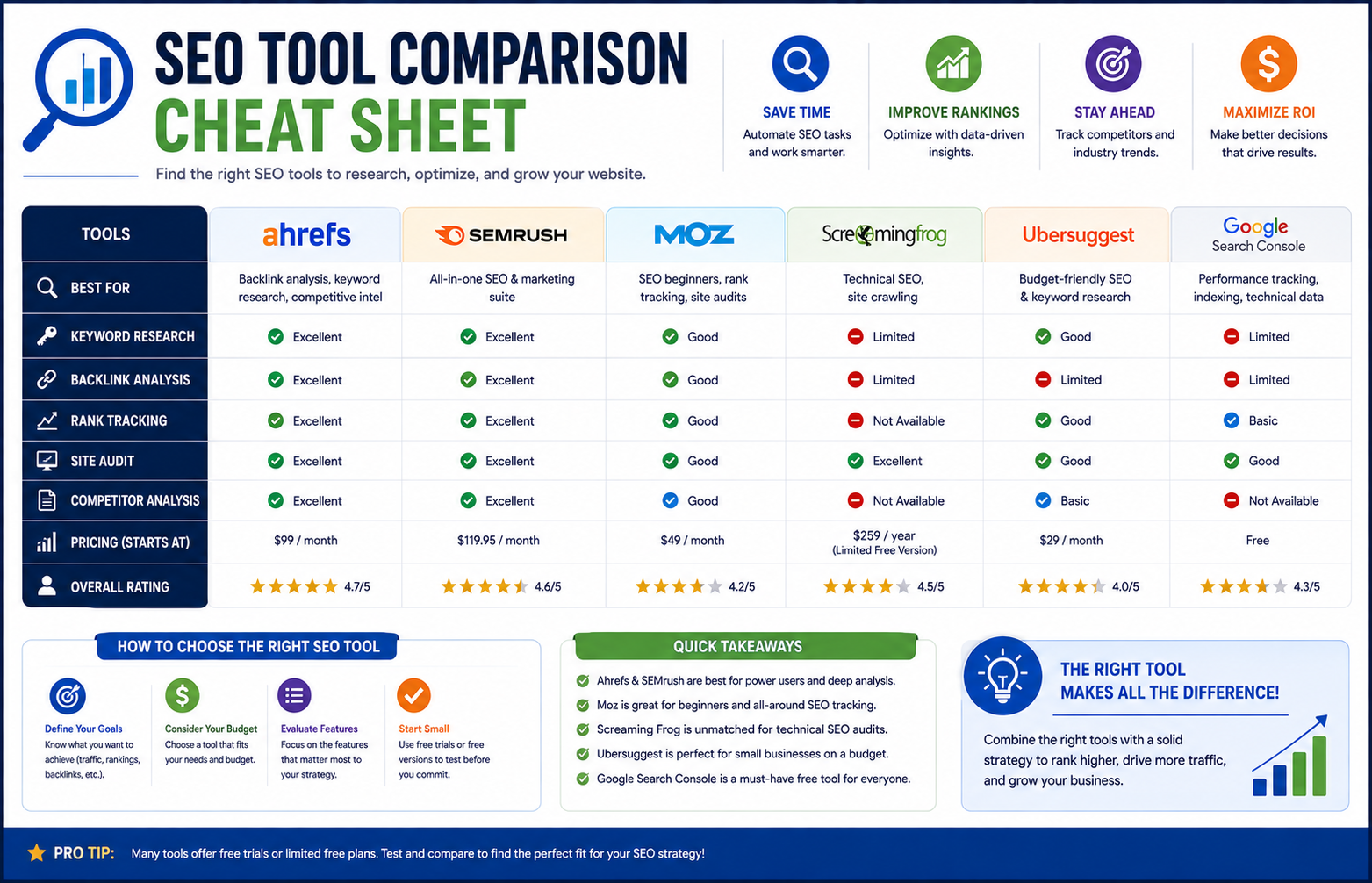
| Tool | Best For | Starting Price |
|---|---|---|
| Semrush | All-in-one SEO platform | $139.95/month |
| Ahrefs | Backlink analysis and off-page SEO | $129/month |
| SurferSEO | On-page content optimization | $99/month |
| Screaming Frog | Technical SEO audits | Free (500 URLs) |
| Google Search Console | Free Google performance data | Free |
| AnswerThePublic | Keyword question discovery | $6.66/month |
| Moz Pro | All-purpose organic SEO | $99/month |
Conclusion
What are the SEO tools you need depends on your goals and budget. But covering the five core functions—SEO keyword research, technical audits, rank tracking, content optimization, and reporting—is essential for any successful SEO program. Start with free tools like Google Search Console and Screaming Frog, then scale to paid platforms as your needs grow.
Want a tailored SEO tool stack that fits your budget, platform, and business goals—so you can stop guessing and start ranking?
Get in touch with Orbitix today.